



Week Ending April 10, 2026
Thematic Spotlight: Oil Prices Are Falling — Here’s Why That’s Not the Whole Story
Crude oil has been volatile lately, and when energy prices move, it’s natural to wonder what that means for consumers and the broader economy. A longer-term look at the data offers some useful perspective.
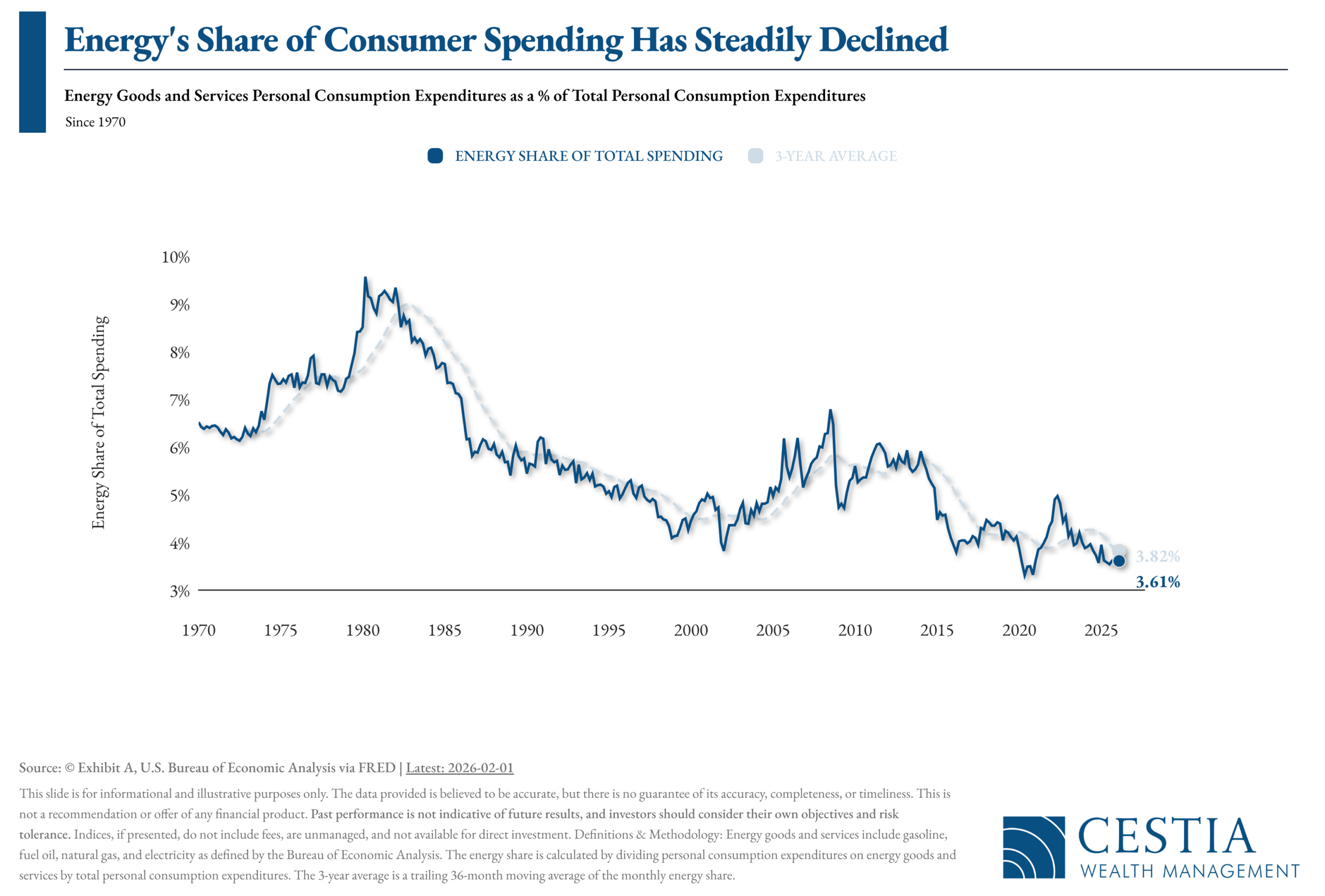
Energy’s share of total consumer spending — covering gasoline, fuel oil, natural gas, and electricity — currently sits at just 3.61%, well below the three-year average of 3.82% and a fraction of the nearly 10% peak reached in the early 1980s. In other words, today’s consumers are spending roughly a third of what their predecessors once did on energy as a share of their overall budget.
The implication for investors is meaningful: oil price swings, while attention-grabbing, carry less weight in the consumer economy than they once did. A spike at the pump still stings, but it no longer moves the needle on total household spending the way it did a generation ago. Conversely, a sharp drop in oil prices — like what we’ve seen recently — provides a more modest tailwind than headlines might suggest.
The structural story here is one of gradual efficiency gains, fuel diversification, and a services-driven economy that is simply less energy-intensive than it used to be. That’s worth remembering the next time oil dominates the financial news cycle.

Were the Cockroaches Alone? Dimon IDs Malodorous Mammal at Economy’s Gates
Oil Market Maintains Cautiously Bullish Bias
Busting the AI Youth Unemployment Myth
Jamie Dimon’s Annual Shareholder Letter
Wall Street Predicts Record Trading Revenue amid Market Jitters

Why Taxable Custodial Accounts Beat “Trump Accounts” for Kids’ Savings
What Are Trump Accounts?
The OBBBA, signed into law on July 4, 2025, created a new type of savings account dubbed the “Trump Account” (TA), which can be opened and funded beginning July 4, 2026. The IRS released initial guidance in late 2025 via Notice 2025-68, with formal regulations still pending.
Key mechanics:
- Contributions are limited to $5,000/year per child (after-tax by individuals), with employers able to contribute up to $2,500 (pre-tax). Government and 501(c)(3) organizations can contribute outside the annual cap.
- A pilot program seeds $1,000 into accounts for every U.S. citizen born between 2025–2028, but parents must opt in by filing Form 4547 — it is not automatic.
- Investments are restricted to low-cost index mutual funds or ETFs with a 0.10% expense cap and no leverage. Fidelity
- No withdrawals are permitted before age 18; after that, traditional IRA rules apply, including the age 59½ penalty-free threshold.
- Because employer/government contributions are pre-tax while individual contributions are after-tax, withdrawals will be a mix of taxable and tax-free dollars — similar to a traditional IRA with mixed basis.
Kitces’ Core Argument: Custodial Accounts Win
The article’s central thesis is that regular taxable custodial accounts (UGMA/UTMA) are generally more advantageous than Trump Accounts for most families, once you account for the kiddie tax, flexibility, and conversion complexity. Here’s why:
- The Tax Benefit Is Smaller Than It Appears: Trump Accounts offer tax-deferred growth, but most of that benefit already exists in custodial accounts because of how the kiddie tax works. For 2025, the first $1,350 of a child’s unearned income is covered by the standard deduction and remains tax-free. Income between $1,351 and $2,700 is taxed at the child’s marginal rate. Only amounts exceeding $2,700 trigger the kiddie tax at the parent’s marginal rate. Ourtaxpartner For modest account balances, most investment income in a custodial account already escapes meaningful taxation — without the restrictions of a Trump Account.
- Flexibility Is a Major Advantage of Custodial Accounts: Assets in taxable or custodial structures can be deployed whenever the need arises — college, a car, starting a business, anything. Trump Accounts lock funds up until age 18, then impose IRA rules (59½ for penalty-free access). That’s a decades-long illiquidity trade-off for a tax benefit that may be marginal.
- The Roth Conversion Play Is Complicated by the Kiddie Tax: A commonly cited strategy for Trump Accounts is converting to a Roth IRA at age 18 when the child’s income is low. Once the account becomes a traditional IRA at age 18, one potential strategy is to convert some or all the balance to a Roth IRA during years when the beneficiary’s income is relatively low. If done in a low bracket, the conversion tax could be minimal, and the funds would then grow tax-free for life. However, the kiddie tax creates a significant complication: Income for minors and dependent students may be taxed at their parents’ marginal rate under the kiddie tax, which limits conversion flexibility before the child is fully tax-independent. The kiddie tax applies through age 18 (or age 23 for full-time students supported by parents), meaning the “convert at a low rate” window may be much narrower than it appears.
- Unresolved Gift Tax Ambiguity: The American College of Trust and Estate Counsel (ACTEC) submitted formal comments to the IRS expressing concern that the statute creating Trump Accounts does not clearly state that contributions qualify for the annual gift tax exclusion. Without clarification, contributions could technically be treated as gifts of a future interest rather than a present interest — requiring a gift tax return, adding administrative complexity that does not exist with other planning tools.
The $1,000 Seed: Take It, But Weigh the Rest
The article acknowledges the free $1,000 government seed is worth claiming for eligible children (born 2025–2028), but cautions against letting that headline number drive broader contribution decisions. The restrictions that come with the account may not be worth it beyond capturing that initial subsidy.
Planning Takeaways for Your Practice
| Factor | Trump Account | Custodial UGMA/UTMA |
|---|---|---|
| Contribution limit | $5,000/yr (no earned income required) | Unlimited (gift tax rules apply) |
| Investment options | Index funds/ETFs only, 0.10% expense cap | Open brokerage (stocks, ETFs, etc.) |
| Tax treatment | Tax-deferred; withdrawals partly taxable | Kiddie tax applies to unearned income >$2,700 |
| Withdrawal flexibility | Restricted until 18; IRA rules after | Any time, any purpose |
| Roth conversion opportunity | Yes, but kiddie tax complicates timing | N/A (but Roth IRA if child has earned income) |
| Gift tax clarity | Unresolved as of early 2026 | Well-established |
| Free government seed | $1,000 for 2025–2028 births (opt-in via Form 4547) | None |
Bottom line from Kitces: For most clients, the custodial account’s flexibility advantage outweighs the Trump Account’s deferred growth benefit — especially given how the kiddie tax already shelters a meaningful portion of custodial account income at low rates. The $1,000 seed is worth capturing, but funding Trump Accounts beyond that deserves careful analysis before recommending it over existing vehicles.
SOURCE: kitties.com

Equities
- The S&P 500 gained 3.58% on the week, while the Russell 2000 outperformed with a 3.99% gain, as markets rallied following a U.S.-Iran ceasefire agreement
- AI and semiconductor enthusiasm provided an additional tailwind for the technology sector and broader growth stocks; Large Cap Growth rose 3.79% vs. 2.94% for Large Cap Value
- S&P 500 Q1 2026 earnings growth is projected at 12.6%, which would mark the sixth consecutive quarter of double-digit gains
- Communication Services (+5.89%) and Consumer Discretionary (+5.81%) led sector performance; Energy (-4.07%) was the lone detractor as oil fell to $96.57/barrel on ceasefire news
- International markets joined the rally, with Emerging Markets surging over 7% on the de-escalation trade
Bonds
- Bond prices rose broadly as yields declined across the curve; the 10-year Treasury finished the week at 4.31% and the 2-year dipped 3 basis points to 3.81%, narrowing the 2–10 spread to 50 basis points
- High-yield bonds were the top-performing segment as risk appetite improved and credit spreads tightened; investment-grade and high-yield corporate yields fell to 5.07% and 7.30%, respectively
Macroeconomic Data
- Headline CPI jumped to 3.3% in March 2026 — its highest since mid-2024 — driven largely by energy costs; core CPI held steadier at 2.6%, and core PCE edged down to 3.0% in February
- Consumer finances showed strain as disposable personal income rose just 0.1% in February against a 0.5% spending increase, pointing to a drawdown in savings
- The University of Michigan Consumer Sentiment Index fell to a record low of 47.6 in April, reflecting mounting concern over prices and geopolitical uncertainty
- Durable goods orders came in flat and missed expectations; Q4 2025 GDP was revised down to 0.5%, raising questions about the durability of business investment

(as of Monday’s Market Opening)
| Total Return (1D) | Total Return (1W) | Total Return (MTD) | Total Return (QTD) | Total Return (YTD) | |
| S&P 500 | -0.11% | 3.10% | 4.42% | 4.42% | -0.42% |
| Dow Jones Industrial Average | -0.56% | 2.67% | 3.40% | 3.40% | -0.31% |
| NASDAQ | 0.35% | 4.12% | 6.08% | 6.08% | -1.46% |
| NASDAQ 100 | 0.14% | 3.82% | 5.80% | 5.80% | -0.53% |
| Russell 1000 | -0.15% | 3.39% | 4.34% | 4.34% | -0.14% |
| Russell 2000 | -0.25% | 3.98% | 5.36% | 5.36% | 6.34% |
| Russell 3000 | -0.14% | 3.46% | 4.32% | 4.32% | 0.16% |
| ACWI | -0.02% | 4.02% | 4.82% | 4.82% | 2.51% |
Global Client Survey
We’re inviting you to take part in a quick, anonymous client survey. Your feedback helps us fine-tune our process, elevate your experience, and ensure we’re delivering what matters most to you. This isn’t just about checking a box—it’s about shaping the future of how we serve you. Your voice helps guide our next steps. We’re listening. We’re learning. And we’re grateful for your trust.
Take Our Survey Now (click here)
Disclosures
- Wealth Mechanics™ is a registered trademark of Cestia Wealth Management. Unauthorized use of the trademark, including but not limited to commercial use, reproduction, or imitation without explicit written permission from Cestia Wealth Management, is strictly prohibited.
- Market commentary provided by NewEdge Advisors
- Charts concerning market data are provided by Exhibit A.
- Guides and other downloadable firm material respective to financial planning processes and data are provided and powered by fpPathfinder.
- Advisory services offered through NewEdge Advisors, LLC, a registered investment adviser. Securities offered through NewEdge Securities, LLC. Member FINRA/SIPC. NewEdge Advisors, LLC and NewEdge Securities, LLC are wholly owned subsidiaries of NewEdge Capital Group, LLC.
- Cestia Wealth Management is not a legal tax professional. We offer tax gap analysis for clients who desire to have a comprehensive financial plan, which requires in-depth tax strategy and planning as a distinct part of the overall customized solution. Please consult your tax professional on all matters addressed in this report.
- Information about annuities are not to be considered a recommendation. The information provided should not considered a recommendation to purchase or sell any particular security.
- Investing involves risk, including the potential loss of principal. No investment strategy can guarantee a profit or protect against loss in periods of declining values. Past performance is no guarantee of future results. Please note that individual situations can vary. Therefore, the information presented here should only be relied upon when coordinated with individual professional advice.