



Week Ending December 5, 2025
WEEKLY TOUCHPOINT
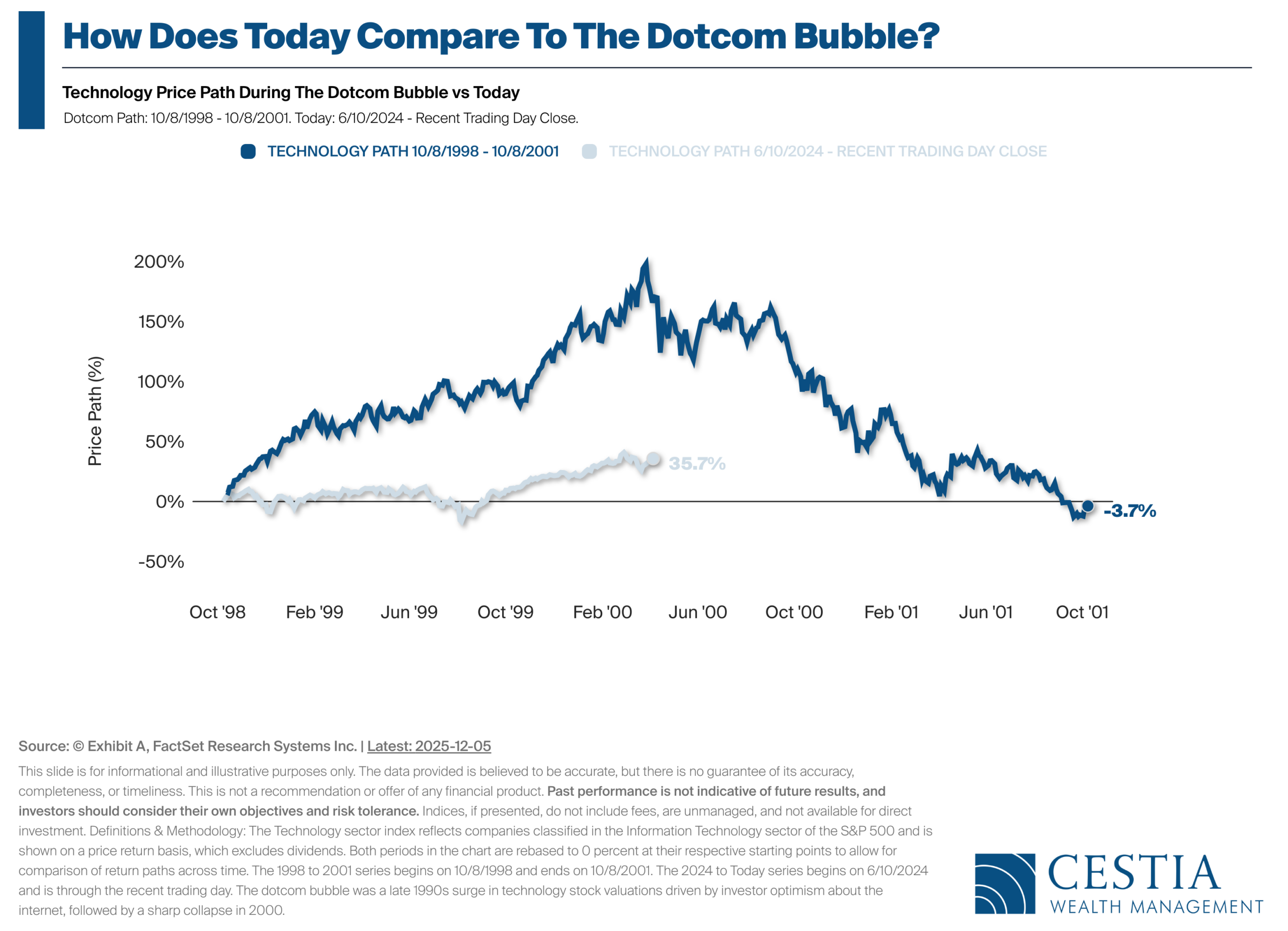
Over the past few weeks, several clients have asked whether today’s surge in technology stocks feels like the Dot-Com bubble all over again. It’s a fair question—history offers valuable perspective—but the data tells a more nuanced story.
Here’s the quick take:
- Two very different return paths. When we compare today’s tech performance (since June 2024) to the Dot-Com years (1998–2001), the patterns simply don’t line up. The market is writing a new script, not replaying an old one.
- Momentum today hasn’t matched the bubble. The Dot-Com era saw extreme run-ups followed by just-as-extreme declines. Today’s returns, while strong, haven’t followed that same boom-and-bust trajectory.
- Context, not prediction. The comparison is useful for perspective—but not for forecasting. Market environments, business models, and profitability across tech are dramatically different now.
- Why this matters for investors. History can guide us, but it doesn’t dictate what comes next. Long-term planning still hinges on diversification, discipline, and avoiding fear-based decisions.
- Bottom line: Today’s tech landscape is not a mirror of 1999. It’s a reminder to stay grounded, stay invested, and let fundamentals—not headlines—drive your long-term strategy.

Michael and Susan Dell to donate $6.25 billion to fund ‘Trump accounts’
Vanguard Raises White Flag Over Crypto ETFs
What If Everything Is Overvalued?
The housing crisis is pushing Gen Z into crypto and economic nihilism
White House Hits the Brakes on Fuel Economy Standards
Traders Say a December Rate Cut Is Coming. The Fed Isn’t so Sure

Where Should I Withdraw My Next Dollar From For Retirement Expenses?
Making tax-efficient retirement withdrawals can significantly impact a client’s long-term financial success. Whether the need is for income, healthcare, education, or charitable giving, each withdrawal decision comes with implications that can affect portfolio longevity and taxation.
This flowchart helps you walk clients through the decision of where to make their next retirement withdrawal. It covers:
- Common retirement expenses such as income needs, medical costs, education, and charitable giving
- Tax treatment of accounts like IRAs, Roth IRAs, HSAs, and 529s
- How to avoid penalties and be cognizant of AGI thresholds and tax bracket shifts
- Strategic use of QCDs and capital gains harvesting
- How to minimize taxes while meeting short- and long-term goals
SOURCE: fpPathfinder

Equities
- Stocks drifted higher as investors continued interpreting delayed economic data and the Fed’s evolving policy path.
- Small-cap stocks showed a spark, outpacing mid- and large-cap names as risk appetite improved.
- Cyclical sectors led the charge, supported by hopes for easier financial conditions ahead.
- Tech took the spotlight—large-cap and AI-related names helped Information Technology become the top-performing sector.
- Defensive areas struggled, with utilities down sharply (-4.48%) and healthcare sliding (-2.72%), while international markets outperformed amid better global sentiment.
Bonds
- The bond market moved lower as Treasury yields climbed, particularly on the long end of the curve.
- The 2-Year yield rose to 3.56%, and the 10-Year ended at 4.14%, widening the curve to 0.58%.
- Higher yields weighed on longer-duration bonds, pushing both government and corporate bonds into negative territory.
- High-yield bonds were the lone bright spot—credit spreads tightened just enough to lift returns.
- Investment-grade yields ticked up to 4.84%, while high-yield fell to 7.06%, signaling improving risk sentiment.
Macroeconomic Data
- A slow drip of economic releases painted a picture of a “low-hire, low-fire” labor market.
- ADP reported a 32K private-sector job loss in November, weaker than expected, while jobless claims improved to 191K.
- Manufacturing stayed soft with ISM’s PMI at 48.2, while services remained in expansion at 52.6, though hiring cooled.
- Inflation remained on track: core PCE rose 0.2%, bringing year-over-year core to 2.8%, slightly better than expected.
- Consumer sentiment turned a corner—University of Michigan reported an uptick to 53.3, helped by stronger expectations.

(as of Monday’s Market Opening)
| Total Return (1D) | Total Return (1W) | Total Return (MTD) | Total Return (QTD) | Total Return (YTD) | |
| S&P 500 | -0.24% | 0.61% | 0.07% | 2.47% | 16.53% |
| Dow Jones Industrial Average | -0.30% | 1.11% | 0.20% | 3.05% | 12.38% |
| NASDAQ | -0.14% | 1.16% | 0.77% | 3.91% | 21.93% |
| NASDAQ 100 | -0.11% | 1.27% | 0.90% | 3.99% | 22.14% |
| Russell 1000 | -0.25% | 0.11% | 0.11% | 2.56% | 17.27% |
| Russell 2000 | 0.23% | 1.04% | 1.04% | 3.88% | 14.65% |
| Russell 3000 | -0.25% | 0.07% | 0.07% | 2.50% | 17.10% |
| ACWI | -0.23% | 0.21% | 0.21% | 2.55% | 21.59% |

Business & Digital Asset Management: Protecting the Invisible Backbone of Your Company
Do You Really Own Your Digital Assets?
- Your website
- Your email
- Your domain name
- Your social media accounts
- Your client platforms
- Your payment processors.
These are the invisible systems that quietly hold your business together. They’re not glamorous, and they’re rarely top of mind—until something breaks, access disappears, or ownership becomes unclear. And by then, the damage is already done. Most companies don’t realize how fragile their digital footprint really is. A single mismanaged asset—an expired domain, a lost login, a vendor transition gone wrong—can disrupt operations, erode trust, and cost far more than time.
Why Digital Asset Management Matters
Businesses today operate in an ecosystem of tools, platforms, and permissions spread across teams, locations, and third-party vendors. Without a plan, that complexity becomes a risk. Especially during:
- Acquisitions or mergers where digital systems must be consolidated
- Rapid growth requiring new permissions, platforms, and integrations
- Brand expansion across multiple domains, emails, and customer-facing channels
- Leadership transitions when institutional knowledge walks out the door
Digital assets are real business assets. But unlike physical property or equipment, their ownership is often vague, undocumented, or siloed.
Common Problems We See
- Domains registered under a former employee’s personal account
- Websites hosted on platforms no one can access
- Social media logins scattered across old email addresses
- Subscription tools tied to unknown credit cards
- No centralized inventory of what the business actually owns
- No continuity plan if a key staff member leaves suddenly
These aren’t minor administrative issues—they’re business continuity risks.
A Better Way Forward: Treat Digital Assets Like Financial Assets
Just as you track cash flow, legal documents, and vendor contracts, your digital presence must be mapped, documented, and protected. Effective Digital Asset Management includes:
- A master inventory of every digital tool, platform, account, and credential
- Clear ownership structure and permission hierarchy
- A continuity plan for outages, turnover, and emergency access
- Centralized storage of logins, renewals, and billing details
- Standardized onboarding & offboarding processes
- System audits to identify vulnerabilities before they become failures
This isn’t just about organization—it’s about control, security, and operational resilience.
The Business Impact
Companies that manage their digital assets well experience:
- Fewer operational bottlenecks
- Faster onboarding for employees
- Reduced cybersecurity risk
- Lower technology costs
- Greater brand consistency
- Stronger valuation in a future sale or transition
If you’re building a business meant to last, managing your digital infrastructure is no longer optional.
Bottom Line
Modern businesses run on digital foundations you can’t afford to leave to chance. Whether you’re scaling, restructuring, or simply tightening operations, having a formal Digital Asset Management strategy ensures your business stays fully in your control—not scattered across email inboxes and vendor accounts.
Global Client Survey
We’re inviting you to take part in a quick, anonymous client survey. Your feedback helps us fine-tune our process, elevate your experience, and ensure we’re delivering what matters most to you. This isn’t just about checking a box—it’s about shaping the future of how we serve you. Your voice helps guide our next steps. We’re listening. We’re learning. And we’re grateful for your trust.
Take Our Survey Now (click here)
Disclosures
- Wealth Mechanics™ is a registered trademark of Cestia Wealth Management. Unauthorized use of the trademark, including but not limited to commercial use, reproduction, or imitation without explicit written permission from Cestia Wealth Management, is strictly prohibited.
- Market commentary provided by NewEdge Advisors
- Charts concerning market data are provided by Exhibit A.
- Guides and other downloadable firm material respective to financial planning processes and data are provided and powered by fpPathfinder.
- Advisory services offered through NewEdge Advisors, LLC, a registered investment adviser. Securities offered through NewEdge Securities, LLC. Member FINRA/SIPC. NewEdge Advisors, LLC and NewEdge Securities, LLC are wholly owned subsidiaries of NewEdge Capital Group, LLC.
- Cestia Wealth Management is not a legal tax professional. We offer tax gap analysis for clients who desire to have a comprehensive financial plan, which requires in-depth tax strategy and planning as a distinct part of the overall customized solution. Please consult your tax professional on all matters addressed in this report.
- Information about annuities are not to be considered a recommendation. The information provided should not considered a recommendation to purchase or sell any particular security.
- Investing involves risk, including the potential loss of principal. No investment strategy can guarantee a profit or protect against loss in periods of declining values. Past performance is no guarantee of future results. Please note that individual situations can vary. Therefore, the information presented here should only be relied upon when coordinated with individual professional advice.