



Week Ending February 6, 2026
WEEKLY TOUCHPOINT
The January Barometer
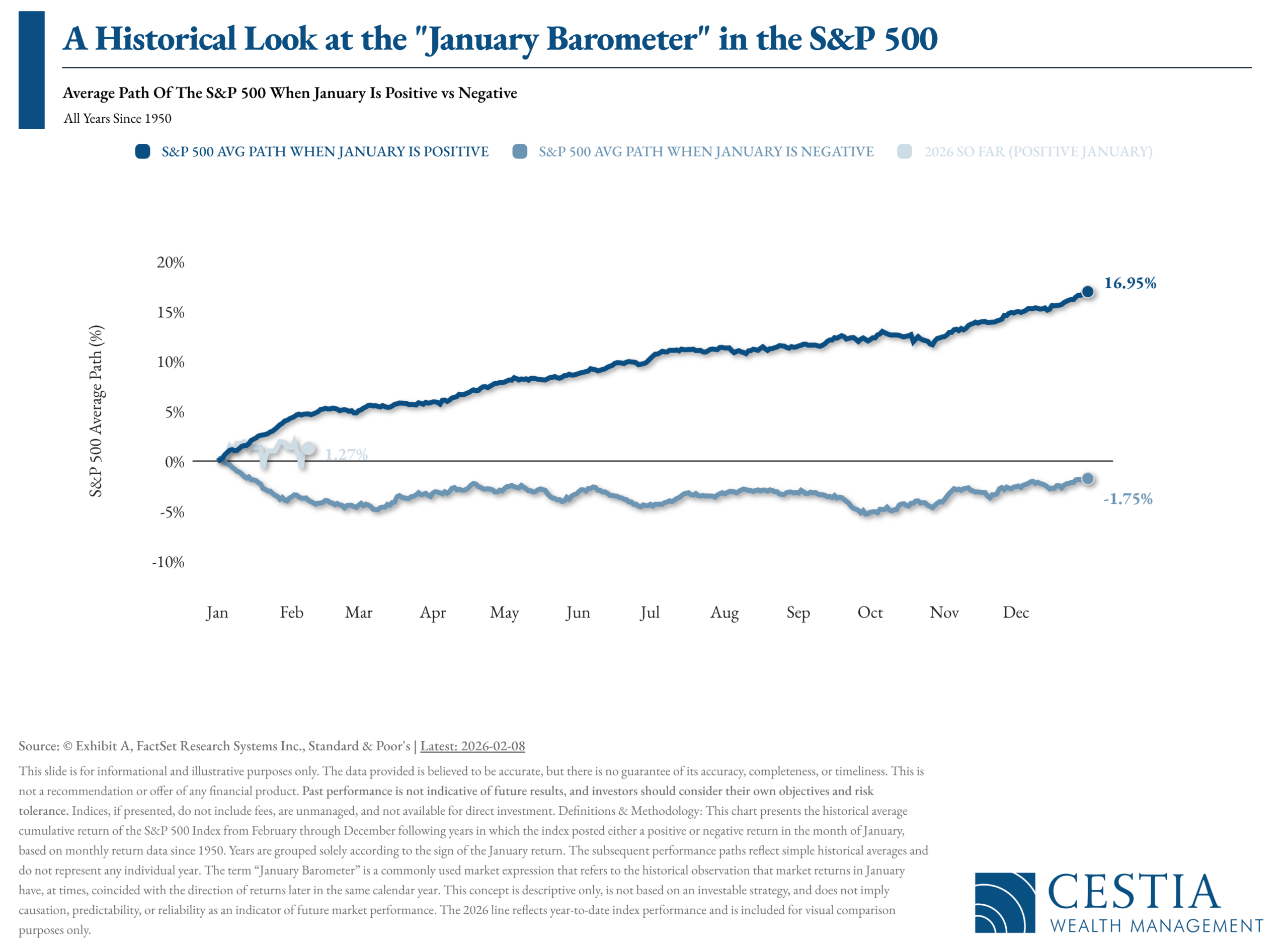
There’s an old Wall Street saying known as the January Barometer—the idea that the market’s tone in January often sets the rhythm for the rest of the year. Historically, when the S&P 500 starts the year in positive territory, the remainder of the year has tended to follow with strength, averaging gains of nearly 17%. In contrast, years that stumble out of the gate with a negative January have, on average, struggled to gain traction and finished modestly lower. In 2026, the market opened the year on a positive note, which offers an interesting data point for investors to keep in context—not as a prediction, but as another reminder that early momentum can matter, even as long-term outcomes remain shaped by far more than a single month.

A Nobel for the Deep Roots of Growth and Prosperity
Trump says U.S. and India reached trade deal, will lower tariffs immediately

Understanding new Roth 401(k) catch-up rules
Starting in 2026 some important changes are coming to the way higher earners who make catch-up contributions to their workplace retirement plans can fund their accounts.
The change, which stems from the SECURE 2.0 Act of 2022, is part of a shift in recent retirement and tax legislationthat emphasizes contributions to Roth accounts, which can have important implications for your retirement planning.
What is the new 401(k) catch-up contribution rule?
If you’re 50 or older and your Federal Insurance Contributions Act (FICA)-taxable earnings are $150,000 or more, any catch-up contributions to your 401(k) will have to be made to a Roth 401(k) with after-tax dollars. That means you’ll lose out on the upfront tax deduction you may have had previously, but you can potentially benefit from the advantages Roths can offer, including tax-free earnings and withdrawals, as long as you meet the 5-year aging rulefor the plan (If the plan allows)
401(k) contribution and catch-up amounts
| 401(k) contributions | 2025 | 2026 |
|---|---|---|
| Contribution amount | $23,500 | $24,500 |
| 50+ catch-up | $7,500 | $8,000 |
| 60-63 catch-up* | $11,250 | $11,250 |
| Catch-up contributions must be to a Roth | Does not apply | In effect for those with FICA earnings above $150,000 in 2025. |
The rule change is permanent, and it is also based on the prior year W-2 form from the employer sponsoring the plan, which means if you earned $150,000 or more for tax year 2025, the change applies to you for the 2026 tax year. Note: If your plan does not offer a Roth 401(k) option, you won’t be able to make catch-up contributions. The 1-year lookback applies to subsequent years as well.
Good to know: If your FICA earnings were under $150,000, you will be unaffected by the rule change and can continue making catch-up contributions to your 401(k), either to a traditional account or to a Roth 401(k), if your plan administrator offers one.
If the change in catch-up contributions is causing you to rethink your retirement saving strategy, here are 5 financial moves to consider that could help keep you on track.
- Consider a health savings account (HSA). In addition to a 401(k), you may be able to contribute to other tax-advantaged accounts. For example, if you’re enrolled in an HSA-eligible health plan, an HSA can help you pay for qualified medical expenses with pre-tax income while also offering potential tax savings that can support retirement goals.
- The money you contribute isn’t subject to federal income tax, earnings accumulate tax-free, and withdrawals are not subject to federal income tax when they’re used for qualified medical expenses.2 Also, contributions through employer payroll deduction are not subject to FICA and the Federal Unemployment Tax Act (FUTA) taxes.
- Starting at age 65, you can use savings in your HSA to pay for just about anything, penalty-free. One catch, however, is that you have to pay income tax on HSA dollars used for non-medical expenses, similar to withdrawals from a traditional IRA, even after age 65.
- If you are eligible to contribute to an HSA, contribution limits are $4,400 for self-only coverage and $8,750 for family coverage for 2026. That’s up from $4,300 for self-only coverage and $8,550 for family coverage in 2025. If you and your spouse (if applicable) are both age 55 or over, not enrolled in Medicare, and otherwise eligible, you each can make a $1,000 HSA catch-up contribution in 2026, but you must do so in separate HSAs.
- Max out your regular contributions. For 2026, the maximum contribution amount for all 401(k) saversregardless of age increases to $24,500. That means you can put an additional $1,000 away in tax-advantaged accounts. Your contributions would be separate from any matching funds your employer may contribute, and do not count toward your own contribution limit for the year. There is an aggregate employee and employer contribution limit. That limit is $72,000 in 2026.
- Consider partial contributions to a Roth IRA. If you’re looking for additional Roth options, you may be able to contribute to a Roth IRA. Single filers with modified adjusted gross income (MAGI) between $150,000 and $165,000 in 2025, and $153,000 and $168,000 in 2026 can make partial contributions to a Roth IRA. The same is true for couples who are married filing jointly with MAGI between $236,000 and $246,000 in 2025 and $242,000 and $252,000 in 2026. Note: Single filers and those who are married filing jointly with MAGI above these amounts for tax years 2025 and 2026 can’t make contributions to a Roth IRA.
- Contributions for prior tax years can be made up until the tax filing deadline of the current tax year. Both you and your spouse, if applicable, can make independent contributions. If you think the income ranges are close to the mandatory Roth cutoff point of $150,000, note that FICA earnings differ from MAGI, which is calculated using your adjusted gross income (AGI) and may be lower than FICA earnings due to certain deductions and adjustments.
- Also note that contributions to a Roth IRA and a Roth 401(k) must each meet a separate 5-year aging rule to avoid taxes and penalties.
- Think about contributing to a traditional IRA. Regardless of whether you’re covered by a workplace retirement plan, you can still make nondeductible contributions to a traditional IRA up to the annual contribution limit, which is $7,000 for tax-year 2025 and $7,500 for tax-year 2026. Individuals who are age 50 and older can make catch-up contributions of $1,000 and $1,100 in those respective years. Nondeductible contributions won’t lower your tax bill, but funds in the account can grow tax-deferred until you withdraw them in retirement. (That’s different from a standard brokerage account where earnings and dividends could be taxed annually.) Also, you could convert those funds to a Roth IRA using a backdoor conversion later.
- Convert traditional IRA funds to a Roth IRA. A backdoor Roth IRA conversion is a way of moving money into a Roth IRA by making nondeductible contributions—or contributions on which you do not take a tax deduction—to a traditional IRA and then converting those funds into a Roth IRA. It’s different from a standard Roth conversion, which is the transfer of tax-deductible contributions in a traditional IRA to a Roth IRA. While a standard Roth conversion would be fully taxable to you in the year of conversion, a backdoor Roth conversion could have some complex tax considerations, especially if any IRAs you own contain tax-deferred funds, which are considered in aggregate for tax purposes with a Roth conversion. Converted balances to a Roth must also meet a separate 5-year aging rule to avoid penalties on withdrawals.
While no one likes to lose a tax benefit or deduction, with some additional planning you can minimize its impact. Remember, it’s always best to consult with a tax or financial professional about your retirement savings goals so you can come up with a plan that best suits your needs.
SOURCE: Fidelity

Equities
- Markets finished the week mixed and choppy, with technology stocks stumbling as renewed AI concerns surfaced.
- Mega-cap tech earnings grabbed headlines after companies dialed up AI capital spending plans, unsettling investors who are now questioning the pace and payoff.
- Small- and mid-cap stocks quietly outperformed, while value edged out growth—suggesting investors are rotating toward more cyclical, fundamentals-driven areas.
- The Dow Jones Industrial Average crossed 50,000 for the first time, setting a new milestone even as other parts of the market lagged.
- Sector leadership leaned defensive and cyclical—consumer staples, industrials, energy, and materials led, while tech and consumer discretionary trailed.
Bonds
- Bonds delivered positive returns as Treasury yields declined across the curve on signs of cooling in the labor market.
- The 2-year yield fell to 3.50% and the 10-year slipped to 4.20%, benefiting longer-duration government bonds.
- Long-duration Treasuries were the standout performers, while short-duration high-yield bonds lagged.
- Corporate bond yields ended the week at 4.84% for investment-grade and 7.04% for high yield, still offering meaningful income for patient investors.
Macroeconomic Data
- Manufacturing data surprised to the upside, with the ISM Manufacturing Index rising to 52.6, its strongest reading since mid-2022.
- Services activity remained resilient as the ISM Services Index held at 53.8, supported by steady new orders.
- Labor market data softened noticeably: ADP payroll growth slowed, job openings fell to an eight-year low, and weekly jobless claims jumped.
- Layoff announcements spiked sharply in January, reaching the highest January total since 2009, signaling growing employer caution.
- Despite the noise, consumer sentiment improved, hitting a six-month high—suggesting households remain cautiously optimistic.

(as of Monday’s Market Opening)
| Total Return
(1D) |
Total Return
(1W) |
Total Return (MTD) | Total Return (QTD) | Total Return (YTD) | |
| S&P 500 | 1.97% | -0.63% | -0.10% | 1.27% | 1.27% |
| Dow Jones Industrial Average | 2.47% | 1.43% | 2.50% | 4.27% | 4.27% |
| NASDAQ | 2.18% | -2.38% | -1.84% | -0.91% | -0.91% |
| NASDAQ 100 | 2.15% | -2.58% | -1.87% | -0.69% | -0.69% |
| Russell 1000 | 2.03% | 0.02% | 0.02% | 1.37% | 1.37% |
| Russell 2000 | 3.59% | 2.07% | 2.07% | 7.66% | 7.66% |
| Russell 3000 | 2.11% | 0.13% | 0.13% | 1.64% | 1.64% |
| ACWI | 2.14% | 0.54% | 0.54% | 3.39% | 3.39% |
Global Client Survey
We’re inviting you to take part in a quick, anonymous client survey. Your feedback helps us fine-tune our process, elevate your experience, and ensure we’re delivering what matters most to you. This isn’t just about checking a box—it’s about shaping the future of how we serve you. Your voice helps guide our next steps. We’re listening. We’re learning. And we’re grateful for your trust.
Take Our Survey Now
Disclosures
- Wealth Mechanics™ is a registered trademark of Cestia Wealth Management. Unauthorized use of the trademark, including but not limited to commercial use, reproduction, or imitation without explicit written permission from Cestia Wealth Management, is strictly prohibited.
- Market commentary provided by NewEdge Advisors
- Charts concerning market data are provided by Exhibit A.
- Guides and other downloadable firm material respective to financial planning processes and data are provided and powered by fpPathfinder.
- Advisory services offered through NewEdge Advisors, LLC, a registered investment adviser. Securities offered through NewEdge Securities, LLC. Member FINRA/SIPC. NewEdge Advisors, LLC and NewEdge Securities, LLC are wholly owned subsidiaries of NewEdge Capital Group, LLC.
- Cestia Wealth Management is not a legal tax professional. We offer tax gap analysis for clients who desire to have a comprehensive financial plan, which requires in-depth tax strategy and planning as a distinct part of the overall customized solution. Please consult your tax professional on all matters addressed in this report.
- Information about annuities are not to be considered a recommendation. The information provided should not considered a recommendation to purchase or sell any particular security.
- Investing involves risk, including the potential loss of principal. No investment strategy can guarantee a profit or protect against loss in periods of declining values. Past performance is no guarantee of future results. Please note that individual situations can vary. Therefore, the information presented here should only be relied upon when coordinated with individual professional advice.