



Week Ending June 19, 2026
The Retirement Math Most People Get Wrong
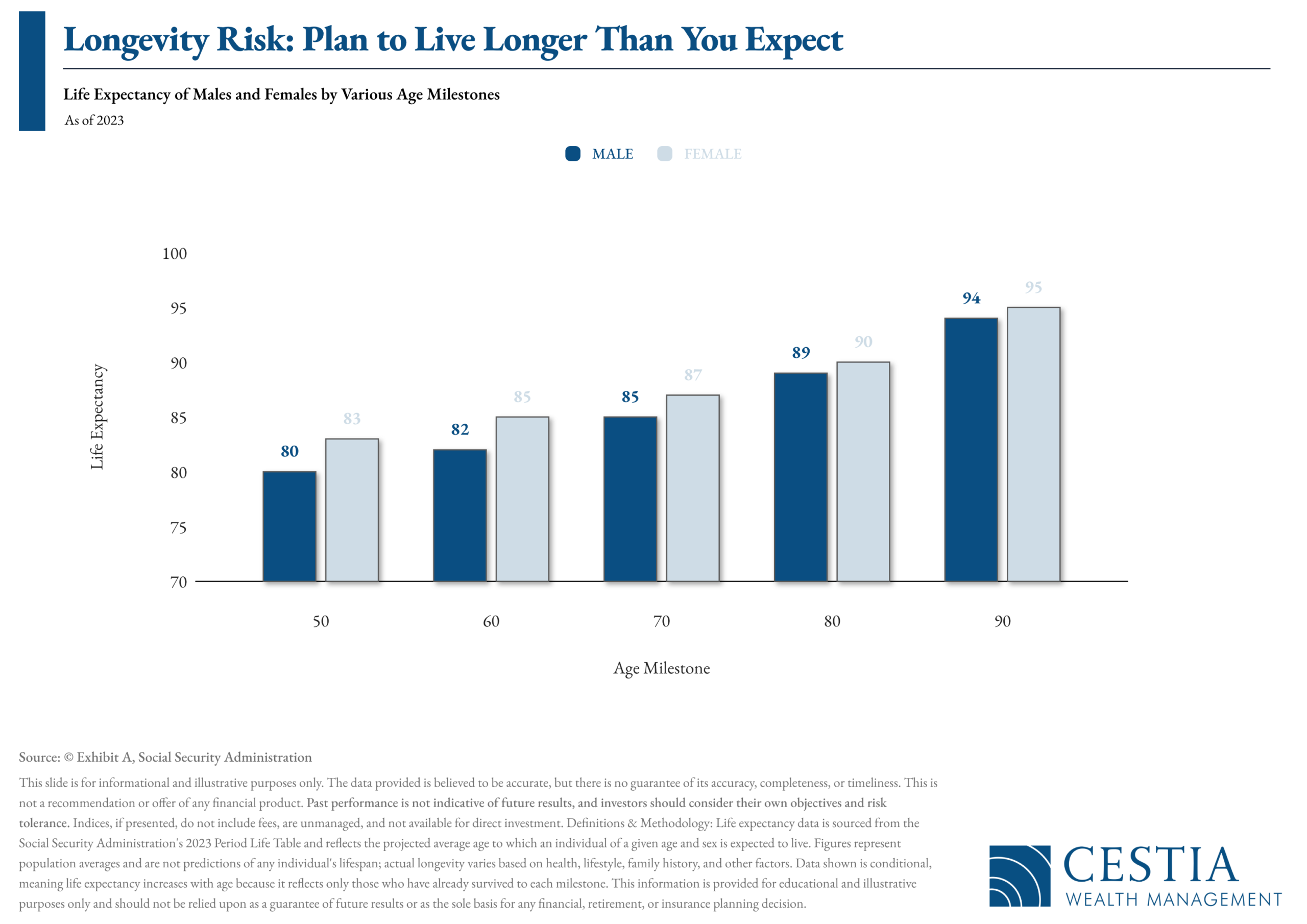
There is a concept in longevity planning called conditional life expectancy, and it changes the retirement conversation entirely. Unlike the life expectancy figures most people reference — those assigned at birth — conditional life expectancy tells you how long you are statistically expected to live based on the age you have already reached. The implication is counterintuitive but important: the older you get, the longer you are likely to live.
The data makes this concrete. A 50-year-old man today can expect to live to approximately 80; a woman of the same age, to 83. But reaching 80 is not the finish line — it is a recalibration point. A man who reaches 80 now carries a life expectancy of 89. If he reaches 90, that number climbs to 94. Women live longer than men at every age along this curve, though the gap narrows — from roughly three years at age 50 to approximately one year by age 90. In other words, making it to 80 does not mean a person is near the end of their statistical runway. It means the odds of reaching their 90s just increased considerably.
The planning implication is direct. A 30-year retirement — from 65 to 95 — was once an outlier. It is now a realistic planning horizon for a meaningful portion of the population. The harder problem, then, is not running out of time. It is the risk of outliving financial resources. That requires income strategies built to hold up well into a client’s 90s, a spending pace calibrated to go the distance, and coverage solutions designed around a longer life than most people instinctively plan for. Longevity is no longer a tail risk. For many clients, it is the baseline.

Memory Crunch Prompts Bets on Micron Earnings Blowout

Foundation in Digital Assets, Part 5: How Investors Gain Exposure
In the first four parts of this series, we explored the technology behind digital assets, the distinction between digital currency and cryptocurrency, the regulatory framework stablecoins now operate within, and how decentralized finance is reshaping traditional lending and borrowing. In this final installment, we turn to a practical question: if a client wants exposure to digital assets, how do they actually get it?
There are three primary pathways, each carrying a distinct set of trade-offs.
Exchange-Traded Products (ETPs). The most significant development in this space has been the arrival of spot Bitcoin and Ethereum ETFs in the U.S. market. Approved by the SEC in January 2024 for Bitcoin and July 2024 for Ethereum, these products eliminated the need for direct cryptocurrency custody while providing regulated exposure to digital assets. The ETP market has since expanded to include products tracking XRP, Solana, and multi-asset crypto indices. Major wealth management platforms — including Wells Fargo, Bank of America, and Vanguard — have opened access to Bitcoin ETFs for their clients, a shift that marks a meaningful transition from early-adopter territory toward mainstream distribution. ETPs offer accessibility and familiarity; they trade on regulated exchanges and sit inside existing brokerage accounts. Their limitation is that they track the price of an underlying asset — investors do not hold the asset itself. XT.comDL News
Direct Ownership. Investors may also purchase digital assets directly through regulated exchanges and hold them in a digital wallet. This approach provides full ownership of the asset but introduces a layer of responsibility that traditional investing does not: custody. Unlike a brokerage account, where an established institution holds assets on your behalf, direct ownership requires a deliberate decision about how and where to store private keys. Losses from lost credentials or exchange failures are generally not recoverable.
Custody Considerations. Whether an investor chooses an ETP or direct ownership, custody deserves careful attention. Self-custody — storing assets in a personal hardware wallet — provides maximum control but also maximum responsibility. Institutional custody through regulated providers offers infrastructure and insurance, but introduces counterparty exposure. Neither approach is inherently superior; the right choice depends on the investor’s technical comfort, risk tolerance, and overall portfolio context.
Digital asset exposure has become more accessible than at any prior point in the asset class’s history. That accessibility does not change the underlying risk profile. Volatility remains elevated relative to most traditional asset classes, and the appropriate role — if any — for digital assets in a given client’s portfolio is a conversation best held within the context of their broader financial plan.
This concludes the Foundation in Digital Assets series. We hope this five-part framework has provided a clearer vocabulary for evaluating digital assets with discipline and perspective.
Source: Educational framework adapted from materials published by the Digital Assets Council of Financial Professionals (DACFP), an independent educational organization recognized by the CFP Board of Standards, CFA Institute, and listed in FINRA’s database of professional designations.

Equities
- Equity markets advanced on easing Middle East tensions and falling oil prices, with gains broad enough to overcome a hawkish pivot from the Federal Reserve
- Small-cap stocks led the way, outpacing large- and mid-caps; growth outperformed value across the board, with the widest gap in small-caps
- Seven of eleven S&P 500 sectors finished higher, led by Information Technology and Industrials
- Utilities was a notable exception among defensives, posting solid gains; Consumer Staples and Health Care were the week’s laggards
- Energy was the worst-performing sector as oil prices fell on optimism surrounding Iran peace talks
- International equities outperformed domestic markets; emerging markets surged more than 7%, buoyed by the oil price pullback
Bonds
- Bond markets were mixed — long-duration issues rallied while short and intermediate maturities slipped into negative territory
- Long government bonds led fixed income performance; high-yield outperformed Treasuries and investment-grade corporates at the short and intermediate segments
- The 2-year Treasury yield rose to 4.19%, driven by a sharp Wednesday move as the FOMC’s hawkish tone repriced rate-hike expectations; the 10-year held near flat at 4.46%, narrowing the 2-10 spread to just 0.27%
- The U.S. Aggregate Index ended the week yielding 4.74%; the U.S. Corporate Index closed at 5.20%
Macroeconomic Data
- The FOMC held the federal funds rate steady at 3.50%–3.75% in a unanimous vote — widely expected — but the updated Summary of Economic Projections delivered a hawkish surprise, with the median dot now pointing to a rate hike by year-end, reversing March’s projection for a cut
- In his first press conference as Fed Chair, Kevin Warsh declined to submit his own dot or offer forward guidance, and announced five internal task forces to review Fed communications, balance sheet policy, data sources, productivity and jobs, and the inflation framework — with most work targeted for completion by year-end
- Retail sales rose 0.9% in May, beating expectations; even stripping out the boost from higher gasoline prices, the control group topped forecasts
- Industrial production edged up just 0.1%, below expectations, with manufacturing output flat and capacity utilization holding modestly below its long-term average

(as of Monday’s Market Opening)
| Total Return
(1D) |
Total Return
(1W) |
Total Return (MTD) | Total Return (QTD) | Total Return
(YTD) |
|
| S&P 500 | -0.37% | -0.51% | -1.42% | 14.46% | 9.16% |
| Dow Jones Industrial Average | 0.29% | -0.55% | 1.33% | 11.59% | 7.59% |
| NASDAQ | -1.32% | -0.80% | -2.99% | 21.19% | 12.58% |
| NASDAQ 100 | -0.19% | 1.26% | 0.05% | 27.83% | 20.19% |
| Russell 1000 | -0.36% | -1.16% | -1.24% | 14.37% | 9.46% |
| Russell 2000 | 0.88% | 1.20% | 2.91% | 20.52% | 21.64% |
| Russell 3000 | -0.27% | -0.95% | -0.96% | 14.58% | 10.01% |
| ACWI | -0.10% | -0.28% | 0.05% | 14.63% | 12.10% |
Global Client Survey
We’re inviting you to take part in a quick, anonymous client survey. Your feedback helps us fine-tune our process, elevate your experience, and ensure we’re delivering what matters most to you. This isn’t just about checking a box—it’s about shaping the future of how we serve you. Your voice helps guide our next steps. We’re listening. We’re learning. And we’re grateful for your trust.
Take Our Survey Now (click here)
Disclosures
- Wealth Mechanics™ is a registered trademark of Cestia Wealth Management. Unauthorized use of the trademark, including but not limited to commercial use, reproduction, or imitation without explicit written permission from Cestia Wealth Management, is strictly prohibited.
- Market commentary provided by NewEdge Advisors
- Charts concerning market data are provided by Exhibit A.
- Guides and other downloadable firm material respective to financial planning processes and data are provided and powered by fpPathfinder.
- Advisory services offered through NewEdge Advisors, LLC, a registered investment adviser. Securities offered through NewEdge Securities, LLC. Member FINRA/SIPC. NewEdge Advisors, LLC and NewEdge Securities, LLC are wholly owned subsidiaries of NewEdge Capital Group, LLC.
- Cestia Wealth Management is not a legal tax professional. We offer tax gap analysis for clients who desire to have a comprehensive financial plan, which requires in-depth tax strategy and planning as a distinct part of the overall customized solution. Please consult your tax professional on all matters addressed in this report.
- Information about annuities are not to be considered a recommendation. The information provided should not considered a recommendation to purchase or sell any particular security.
- Investing involves risk, including the potential loss of principal. No investment strategy can guarantee a profit or protect against loss in periods of declining values. Past performance is no guarantee of future results. Please note that individual situations can vary. Therefore, the information presented here should only be relied upon when coordinated with individual professional advice.