



Week Ending June 5, 2026
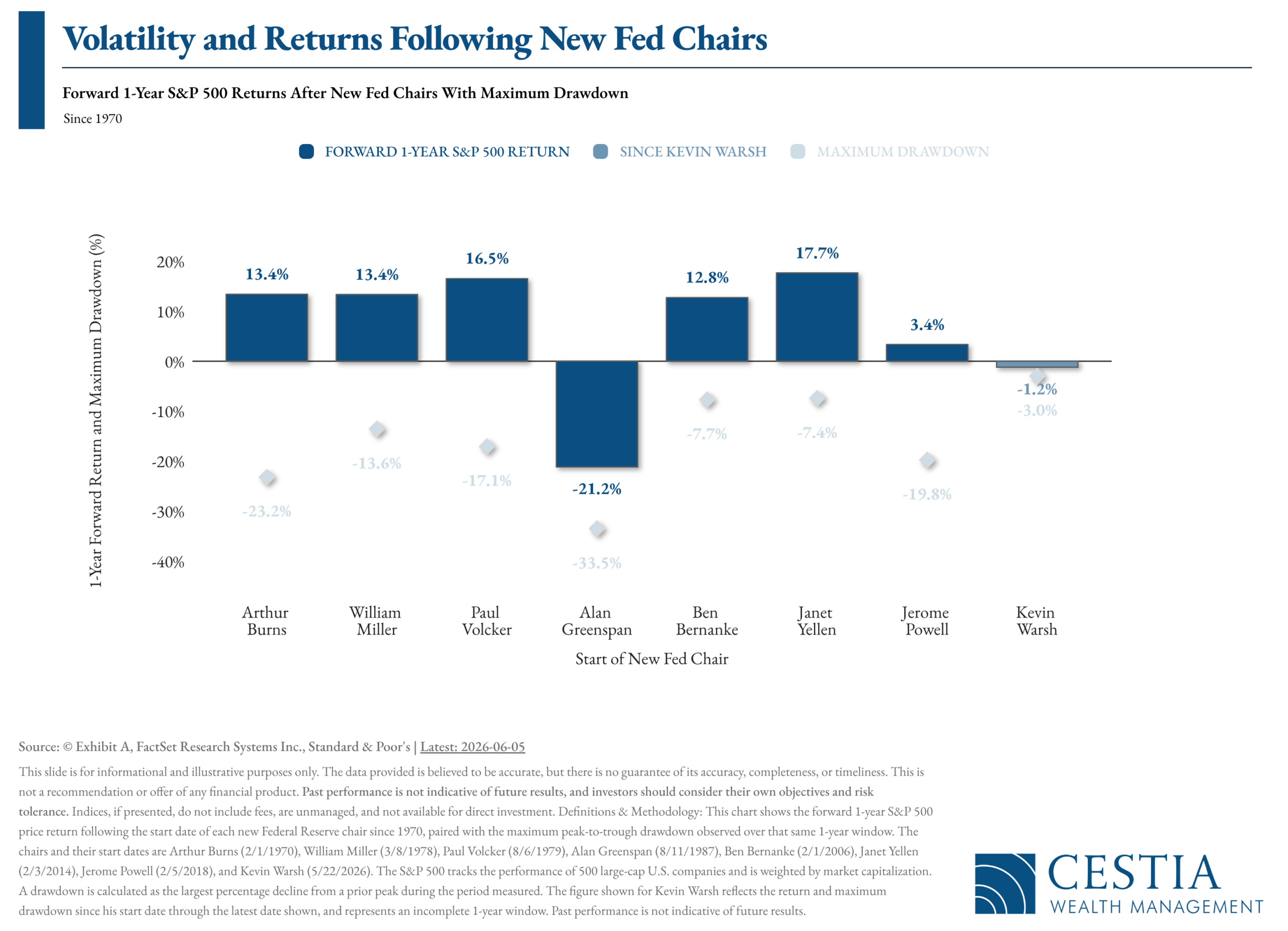
Navigating volatility around Fed leadership transitions
A change at the helm of the Federal Reserve often stirs uncertainty in financial markets — but history suggests that short-term turbulence has rarely defined the outcome. With Kevin Warsh assuming the Chair role on May 22, 2025, we examined how markets have performed in the first year following each new Chair since 1970.

SpaceX not the behemoth everyone thought
Analyst Flags Conflicting USA-Iran War Statements
Oil Rebounds on Fresh Middle East Supply Risk Pricing
Trump finds an AI policy he can live with
As Anthropic Files for IPO, AI Savings Disappoint America’s C-Suites

Foundation in Digital Assets | Part 3 of 5
Stablecoins and the GENIUS Act: Bringing Order to the Middle Ground
In Part 2, we drew a clear line between digital currency and cryptocurrency — centralized versus decentralized, institution-controlled versus protocol-governed. Stablecoins occupy the interesting middle ground between those two worlds, which is precisely what makes them interesting to understand.
What Is a Stablecoin?
A stablecoin is a type of cryptocurrency engineered to hold a steady value. Unlike Bitcoin or Ethereum — whose prices can move sharply in a matter of hours — a stablecoin is designed to maintain a consistent price, typically pegged 1:1 to a fiat currency such as the U.S. dollar.
The stability is achieved through reserves. The most common structure is straightforward: for every stablecoin in circulation, the issuer holds one dollar (or its equivalent in short-term U.S. Treasury securities) in reserve. When a holder redeems their stablecoin, the issuer returns the corresponding dollar. Think of it as a digital dollar token that moves on blockchain rails — settling in seconds, crossing borders without a correspondent bank, and operating around the clock.
The two most widely used stablecoins today are USDT (Tether), the largest by market capitalization, and USDC (USD Coin), issued by Circle and known for its regular independent reserve audits. Together, fiat-backed stablecoins represent the vast majority of a market now valued at approximately $320 billion.
Why Stablecoins Matter
Stablecoins solve one of the most practical limitations of cryptocurrency: volatility. They allow participants to move value quickly and inexpensively across the digital asset ecosystem without converting back to traditional currency at every step. For this reason, they have become the primary medium of exchange within decentralized finance — a topic we will address in Part 4.
They also serve a growing role in payments, cross-border transfers, and, increasingly, mainstream financial services. Visa, PayPal, and several major banks have begun integrating stablecoin infrastructure into their settlement systems.
The GENIUS Act: A Regulatory Milestone
For years, stablecoins operated in a regulatory gray area — widely used, but without a clear federal framework governing how they should be backed, audited, or supervised. That changed on July 18, 2025, when President Trump signed the GENIUS Act (Guiding and Establishing National Innovation for U.S. Stablecoins) into law.
The GENIUS Act is the first federal law to create a comprehensive regulatory framework for payment stablecoins — digital tokens pegged to monetary value and intended for payments. Passed with strong bipartisan support (308–122 in the House, 68–30 in the Senate), the law establishes who may legally issue a stablecoin in the United States, how reserves must be held and disclosed, and which federal or state regulator is responsible for oversight. It replaces a patchwork of state and federal guidance with enforceable standards for reserve assets, redemption rights, disclosures, and custody — and clarifies that compliant stablecoins are neither securities nor commodities.
Implementing regulations are being finalized by the OCC, Federal Reserve, FDIC, and NCUA, with the Act set to take effect no later than January 18, 2027.
What This Means for Clients
The GENIUS Act does not make stablecoins an investment recommendation. What it does is bring a major segment of the digital asset market into a regulated framework — one with reserve requirements, redemption protections, and federal supervision that did not previously exist. For clients seeking to understand how the digital asset landscape is evolving, this is a meaningful development worth tracking.
Next in the series — Part 4: Decentralized Finance (DeFi). We examine how blockchain-based financial services are being built outside the traditional banking system — and what that means for the future of lending, borrowing, and yield.
Source: Digital Assets Council of Financial Professionals (DACFP), an independent educational organization recognized by the CFP Board of Standards, CFA Institute, and listed in FINRA’s database of professional designations.

EQUITIES
- Broad equity markets pulled back from recent highs, as a pronounced decline in technology shares weighed on overall performance.
- Value stocks outperformed growth stocks across market capitalizations, extending year-to-date leads for large-cap and mid-cap value.
- Mid-cap equities demonstrated the greatest resilience during the week’s downturn; small-caps bore the steepest losses, with the Russell 2000 declining approximately 3%.
- Seven of eleven S&P 500 sectors closed higher despite the risk-off environment — Energy led all sectors, supported by rising crude oil prices.
- Defensive and cyclical sectors including Health Care, Real Estate, and Financials each posted solid advances for the week.
- Information Technology was the weakest sector, as momentum behind artificial intelligence names paused meaningfully.
- International equities also declined but outperformed domestic markets on a relative basis.
BONDS
- Fixed income markets sold off as yields rose broadly across the Treasury curve, adding to what has already been a challenging year for bonds.
- The 2-year Treasury yield climbed 19 basis points to 4.17%, up from 3.98% at the close of May; the 10-year Treasury yield rose 10 basis points to 4.55%.
- The 2s/10s slope flattened from 0.47% to 0.38%, reflecting the steeper move at the front end of the curve.
- The Bloomberg U.S. Aggregate Bond Index fell 0.54% for the week, pushing its year-to-date return into negative territory at -0.17%.
- Investment-grade corporate yields closed the week at 5.26%, while high-yield corporate yields ended at 7.43%.
MACROECONOMIC DATA
- U.S. economic data continued to reflect an economy with notable underlying resilience, reinforcing expectations that the Federal Reserve will sustain a restrictive policy stance for an extended period.
- The May nonfarm payrolls report was the week’s headline release — 172,000 jobs were added, meaningfully exceeding consensus estimates, while the unemployment rate held at 4.3%.
- Prior months’ job gains were revised upward, suggesting the labor market remains more durable than many economists had projected.
- Wage growth moderated to 3.4% year-over-year, a development that may temper concerns around a wage-price inflation spiral.
- April JOLTS job openings surged to 7.618 million — a substantial surprise relative to the consensus estimate of approximately 6.866 million — underscoring continued tightness in the labor market.
- The U.S. services sector remained in expansion in May, though readings diverged across surveys: ISM’s Services PMI rose to 54.5, signaling solid activity, while S&P Global’s Services PMI registered a more modest 50.7, indicating slower demand growth.

(as of Monday’s Market Opening)
| Total Return (1D) | Total Return (1W) | Total Return (MTD) | Total Return (QTD) | Total Return (YTD) | |
| S&P 500 | 0.81% | -2.06% | -1.80% | 14.01% | 8.73% |
| Dow Jones Industrial Average | 0.30% | -0.12% | -0.03% | 10.09% | 6.15% |
| NASDAQ | 1.39% | -3.76% | -3.35% | 20.74% | 12.16% |
| NASDAQ 100 | 1.94% | -3.26% | -2.68% | 24.34% | 16.91% |
| Russell 1000 | 0.80% | -1.62% | -1.62% | 13.93% | 9.04% |
| Russell 2000 | 1.49% | -1.58% | -1.58% | 15.26% | 16.33% |
| Russell 3000 | 0.84% | -1.54% | -1.54% | 13.91% | 9.36% |
| ACWI | 0.81% | -1.83% | -1.83% | 12.48% | 10.00% |
Global Client Survey
We’re inviting you to take part in a quick, anonymous client survey. Your feedback helps us fine-tune our process, elevate your experience, and ensure we’re delivering what matters most to you. This isn’t just about checking a box—it’s about shaping the future of how we serve you. Your voice helps guide our next steps. We’re listening. We’re learning. And we’re grateful for your trust.
Take Our Survey Now (click here)
Disclosures
- Wealth Mechanics™ is a registered trademark of Cestia Wealth Management. Unauthorized use of the trademark, including but not limited to commercial use, reproduction, or imitation without explicit written permission from Cestia Wealth Management, is strictly prohibited.
- Market commentary provided by NewEdge Advisors
- Charts concerning market data are provided by Exhibit A.
- Guides and other downloadable firm material respective to financial planning processes and data are provided and powered by fpPathfinder.
- Advisory services offered through NewEdge Advisors, LLC, a registered investment adviser. Securities offered through NewEdge Securities, LLC. Member FINRA/SIPC. NewEdge Advisors, LLC and NewEdge Securities, LLC are wholly owned subsidiaries of NewEdge Capital Group, LLC.
- Cestia Wealth Management is not a legal tax professional. We offer tax gap analysis for clients who desire to have a comprehensive financial plan, which requires in-depth tax strategy and planning as a distinct part of the overall customized solution. Please consult your tax professional on all matters addressed in this report.
- Information about annuities are not to be considered a recommendation. The information provided should not considered a recommendation to purchase or sell any particular security.
- Investing involves risk, including the potential loss of principal. No investment strategy can guarantee a profit or protect against loss in periods of declining values. Past performance is no guarantee of future results. Please note that individual situations can vary. Therefore, the information presented here should only be relied upon when coordinated with individual professional advice.