



Week Ending May 29, 2026
A Historical Perspective of Mega IPOs
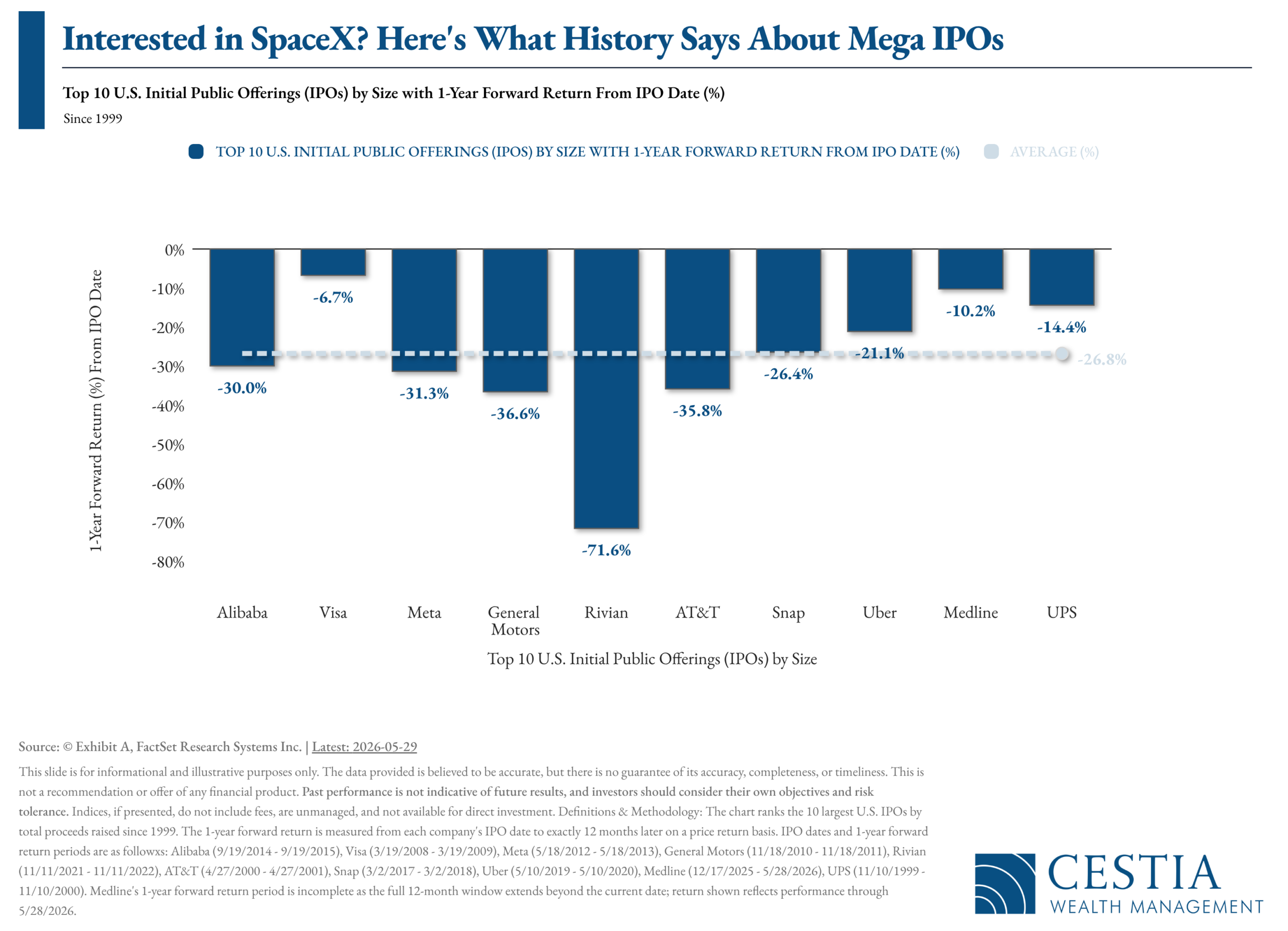
With speculation mounting around potential blockbuster offerings — most notably SpaceX — the IPO market is generating significant investor enthusiasm. Yet a careful review of historical data offers an important counterpoint to that excitement. Among the ten largest U.S. initial public offerings since 1999, measured by deal size, every single one produced a negative return over the twelve months that followed their market debut.
The pattern is striking: an average one-year forward return of -26.8% across the ten largest offerings since 1999 suggests that mega-IPOs tend to arrive overpriced, riding the crest of maximum market enthusiasm. For investors, the lesson is clear — the size of an offering and the volume of media attention surrounding it are not reliable predictors of near-term performance. As always, disciplined valuation and a long-term perspective remain essential, even when the headlines make a new listing feel like a once-in-a-generation opportunity.
Key Takeaway: History suggests that the most celebrated IPOs carry the highest expectations — and those expectations are rarely met within the first year of trading. Proceed with measured caution.

SpaceX not the behemoth everyone thought
What is a Long-Short strategy, and how does it help with Tax-Loss Harvesting
Digitalization, AI in Upstream Oil, Gas is ‘$500B Opportunity’

A Foundation in Digital Assets Part 2: What Is the Difference Between Digital Currency and Cryptocurrency?
In our last installment, we established that blockchain is the technology layer underpinning the digital asset universe — a distributed ledger that records transactions transparently and permanently, without relying on a central authority. With that foundation in place, we can address one of the most common points of confusion among clients: the difference between digital currency and cryptocurrency.
These terms are frequently used as if they were interchangeable. They are not.
Digital Currency: The Broader Category
Digital currency is an umbrella term for any form of money that exists exclusively in electronic form. By this definition, the balance in your checking account is a form of digital currency — it is a number in a database, not a stack of paper bills. So is the dollar amount on a prepaid gift card, or funds transferred through a wire.
The defining characteristic of digital currency is what it is not: physical. Beyond that, digital currencies are typically centralized, meaning a single institution — a bank, a government, a payment platform — controls the record and governs the rules.
The most discussed form of government-issued digital currency today is the Central Bank Digital Currency (CBDC) — essentially a digital version of a nation’s fiat currency, issued and backed by its central bank. More than 130 countries have explored or piloted CBDCs, though adoption varies significantly by region. In the United States, the legislative environment has moved in the opposite direction: Congress has advanced measures that would prohibit the Federal Reserve from issuing a retail CBDC, reflecting concerns about government oversight of individual financial activity. As of this writing, no U.S. digital dollar exists.
Cryptocurrency: A Specific Subset
Cryptocurrency is a type of digital currency — but one defined by two additional properties: cryptographic security and decentralization.
Cryptography refers to the mathematical techniques used to secure transactions and control the creation of new units. Rather than a bank verifying that you have sufficient funds before a transfer clears, a cryptocurrency network uses cryptographic proofs — confirmed by a distributed network of computers — to validate every transaction.
Decentralization means there is no central institution in control. Bitcoin, for example, is maintained by thousands of independent participants worldwide. No government can freeze it, no bank can reverse a transaction, and no single entity sets the rules. The protocol itself — a set of open-source code — governs how the system operates.
This produces the logical relationship worth committing to memory: all cryptocurrencies are digital currencies, but not all digital currencies are cryptocurrencies. The digital balance in your savings account is the former. Bitcoin is both.
Why the Distinction Matters
When clients encounter headlines about a “digital dollar” or read that a country is “launching its own cryptocurrency,” the distinction above is essential context. A government-issued digital currency preserves centralized control — and with it, the familiar protections and risks of government monetary policy. A decentralized cryptocurrency, by contrast, operates outside that system entirely.
Neither is inherently superior. They represent different design philosophies with different trade-offs around control, privacy, stability, and access. Understanding those trade-offs is a prerequisite for evaluating the asset class with clarity — which is precisely the goal of this series.
Next in the series — Part 3: Stablecoins. We examine a hybrid category that attempts to combine the decentralized architecture of cryptocurrency with the price stability of traditional currency, and address the GENIUS Act, the landmark U.S. legislation that established the first federal regulatory framework for stablecoins.
Source: Digital Assets Council of Financial Professionals (DACFP), an independent educational organization recognized by the CFP Board of Standards, CFA Institute, and listed in FINRA’s database of professional designations.

Equities
- Equity indices reached new highs last week, driven by optimism surrounding a prospective Iran-U.S. peace agreement, declining oil prices, and sustained AI momentum.
- Growth stocks continued to outpace value stocks, narrowing value’s year-to-date lead across large-, mid-, and small-cap segments.
- Small caps edged ahead of mid- and large-caps, extending their year-to-date advantage.
- Only four of eleven S&P 500 sectors finished the week in positive territory. Technology led all sectors, with notable contributions from Snowflake, Dell, and Micron.
- Energy was the week’s worst performer, pressured by a sharp decline in WTI crude. Defensive sectors — Consumer Staples and Utilities — were also notable laggards, reflecting a continued risk-on tone among investors.
- International equities were mixed: MSCI EAFE posted a modest gain but trailed domestic markets, while emerging markets surged on AI enthusiasm and retreating energy prices.
Bonds
- Bonds rallied as yields declined across the curve, with the front end leading the move lower.
- Long-duration bonds outperformed, with government bonds narrowly edging corporate bonds at the long end.
- The 2-year Treasury yield fell 15 basis points to 3.98%; the 10-year declined 11 basis points to 4.45%, steepening the 2s/10s spread to 0.47%.
- Credit spreads continued to tighten. Investment-grade corporates ended the week yielding 5.13%; high-yield bonds settled at 7.29%.
- Despite last week’s rally, bonds remain broadly muted on the year — the Bloomberg Aggregate is up less than 0.5% year-to-date, with high yield the standout at a 1.68% return.
Macroeconomic Data
- Inflation remained the dominant theme. April PCE rose 0.4%, in line with expectations. Core PCE — the Fed’s preferred gauge — climbed 0.2% for the month, bringing the year-over-year rate to 3.3%, well above the 2.0% target.
- Personal income was flat in April while consumer spending rose 0.5%, pushing the personal savings rate down to 2.6%.
- Q1 GDP was revised 0.4 percentage points lower to 1.6%, with the reduction driven primarily by an inventory drawdown.
- Elevated inflation paired with softer growth has added meaningful uncertainty to the Fed’s rate path for the remainder of the year.
- Consumer confidence slipped to 93.1 in May per the Conference Board, weighed down by persistent inflation concerns.
- Core capital goods orders fell 1.1% in April, missing expectations — a cautionary signal for business investment.
- Labor market data remained resilient: weekly jobless claims came in at 215,000, near historically low levels, while ADP reported private employers added 109,000 jobs in April, beating estimates. Gains were heavily concentrated in education and health services.

(as of Monday’s Market Opening)
| Total Return (1D) | Total Return (1W) | Total Return (MTD) | Total Return (QTD) | Total Return (YTD) | |
| S&P 500 | 0.47% | 1.91% | 0.47% | 16.66% | 11.25% |
| Dow Jones Industrial Average | 0.06% | 0.96% | 0.06% | 10.19% | 6.25% |
| NASDAQ | 0.68% | 3.08% | 0.68% | 25.78% | 16.84% |
| NASDAQ 100 | 0.72% | 3.63% | 0.72% | 28.70% | 21.00% |
| Russell 1000 | 0.41% | 1.96% | 5.55% | 16.28% | 11.29% |
| Russell 2000 | -0.12% | 1.74% | 4.35% | 16.96% | 18.05% |
| Russell 3000 | 0.45% | 1.96% | 5.54% | 16.22% | 11.58% |
| ACWI | 0.57% | 2.21% | 5.21% | 15.23% | 12.69% |
Global Client Survey
We’re inviting you to take part in a quick, anonymous client survey. Your feedback helps us fine-tune our process, elevate your experience, and ensure we’re delivering what matters most to you. This isn’t just about checking a box—it’s about shaping the future of how we serve you. Your voice helps guide our next steps. We’re listening. We’re learning. And we’re grateful for your trust.
Take Our Survey Now (click here)
Disclosures
- Wealth Mechanics™ is a registered trademark of Cestia Wealth Management. Unauthorized use of the trademark, including but not limited to commercial use, reproduction, or imitation without explicit written permission from Cestia Wealth Management, is strictly prohibited.
- Market commentary provided by NewEdge Advisors
- Charts concerning market data are provided by Exhibit A.
- Guides and other downloadable firm material respective to financial planning processes and data are provided and powered by fpPathfinder.
- Advisory services offered through NewEdge Advisors, LLC, a registered investment adviser. Securities offered through NewEdge Securities, LLC. Member FINRA/SIPC. NewEdge Advisors, LLC and NewEdge Securities, LLC are wholly owned subsidiaries of NewEdge Capital Group, LLC.
- Cestia Wealth Management is not a legal tax professional. We offer tax gap analysis for clients who desire to have a comprehensive financial plan, which requires in-depth tax strategy and planning as a distinct part of the overall customized solution. Please consult your tax professional on all matters addressed in this report.
- Information about annuities are not to be considered a recommendation. The information provided should not considered a recommendation to purchase or sell any particular security.
- Investing involves risk, including the potential loss of principal. No investment strategy can guarantee a profit or protect against loss in periods of declining values. Past performance is no guarantee of future results. Please note that individual situations can vary. Therefore, the information presented here should only be relied upon when coordinated with individual professional advice.